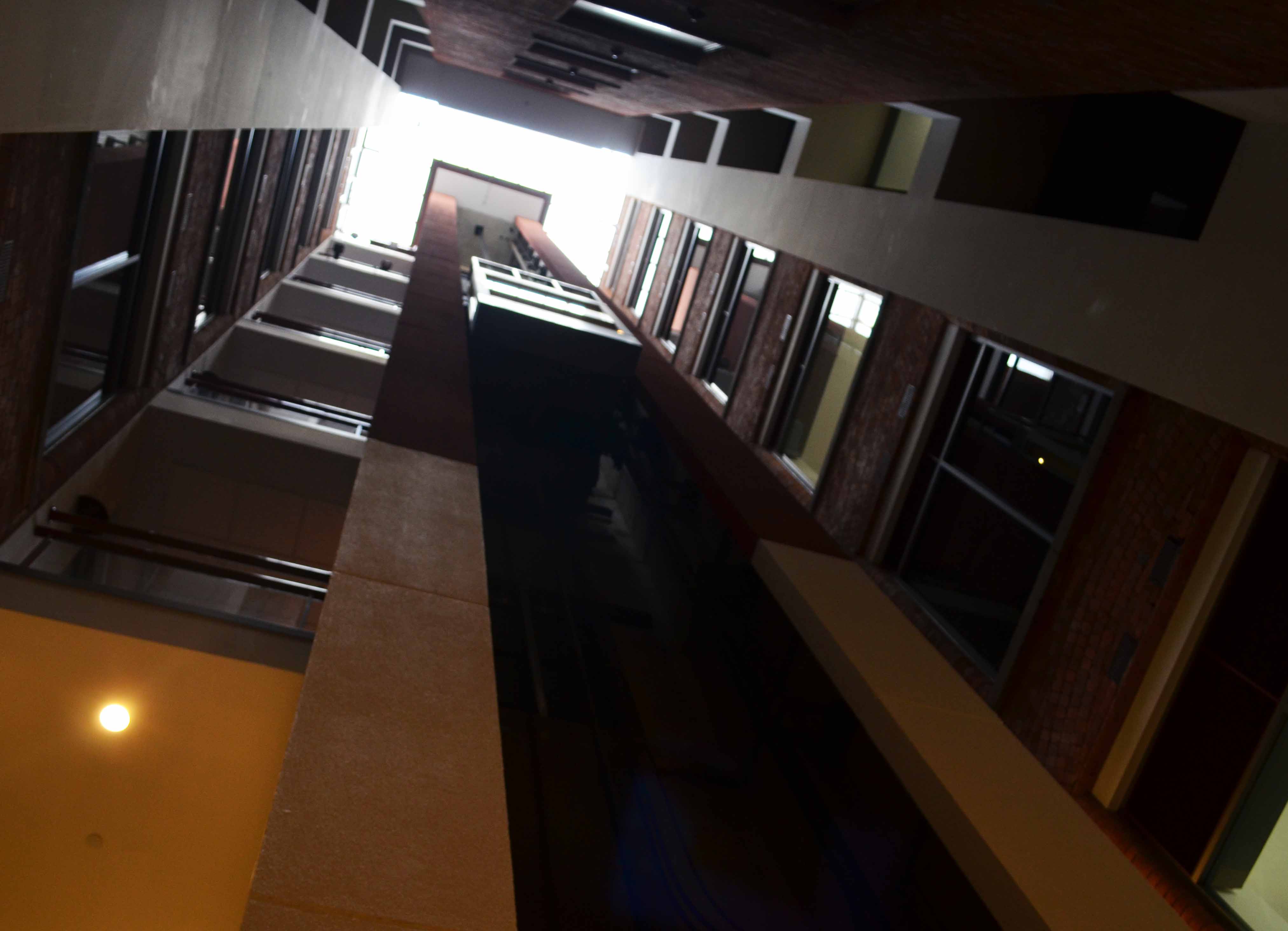
What Is a Light Well?
A light well (szyb świetlny or dziedziniec wewnętrzny in Polish architectural terminology) is an open vertical shaft enclosed by building walls on all sides, designed to admit daylight and air to rooms that cannot be served by windows on external facades. They appear frequently in dense urban housing blocks, particularly in pre-war tenement buildings in Warsaw, Kraków, Łódź, and Wrocław, but also in contemporary multi-unit residential construction where floor plans require rooms positioned away from the perimeter.
The primary function is daylighting. A secondary function, in taller shafts, is natural ventilation through the stack effect. In Polish practice, light wells serving bathrooms, stairwells, and internal kitchens must meet dimensional requirements set out in the Warunki Techniczne.
Regulatory Dimensions in Poland
Paragraph 60 of Rozporządzenie Ministra Infrastruktury z dnia 12 kwietnia 2002 r. (WT) specifies the minimum dimensions of light wells serving habitable rooms. The key parameter is the ratio of well width to well height. A wider well relative to its depth allows a greater fraction of the sky to be seen from a window at the bottom of the shaft — the sky component — which is the dominant driver of daylight factor in these conditions.
| Well Height (m) | Minimum Width (m) | Minimum Plan Area (m²) |
|---|---|---|
| Up to 15 | 3.0 | 9 |
| 15 to 30 | 4.0 | 16 |
| Over 30 | 5.0 | 25 |
Daylight Availability at the Base of a Well
The daylight factor at a window opening onto a light well depends on three geometric quantities: the sky component (the fraction of the unobstructed sky visible through the window), the externally reflected component (light reflected from the opposite well wall), and the internally reflected component.
At the base of a well with a width-to-height ratio of 1:4 — which corresponds approximately to the minimum WT dimensions for a 12-storey building — the sky component drops to a small fraction of the open-sky value. Surveys of pre-war tenement apartments in Warsaw have documented daylight factors below 0.5% in rooms facing interior courtyards with narrow, deep well geometries, which falls below the threshold considered adequate for habitation.
Widening a well from 3 m to 5 m while holding height constant at 15 m increases the visible sky angle from the centre of the base substantially. This is the geometric basis for the WT minimum width requirements.
Wall Reflectance in the Well
The walls enclosing the well contribute reflected light to rooms at lower levels. A well lined with white or light-coloured render (reflectance 0.6–0.7) can deliver 20–30% more light to the base level compared to dark or weathered masonry (reflectance 0.2–0.3). In many tenement buildings, the internal courtyard walls are the only realistic intervention available when reconstruction is constrained by existing structure. Repainting or re-rendering well walls with high-reflectance coatings is a practical, low-cost measure to improve daylight at lower floors.
Roof Glazing and Borrowed Light
Some light wells — particularly in commercial buildings and mixed-use blocks — are enclosed at the top with translucent glazing, creating an atrium rather than an open shaft. While this admits less direct sky radiation compared to an open well, it eliminates rain penetration and improves acoustic separation from outdoor noise. Atrium roofs in Polish construction must comply with fire resistance and smoke ventilation requirements under WT and separate fire safety regulations.
In purely residential applications, open wells are more common. Roof glazing over residential light wells is rare but appears in some post-2010 premium apartment developments in Warsaw and Kraków.
Renovation Constraints
In existing buildings — particularly pre-war tenements that are subject to heritage protection (wpis do rejestru zabytków) — modifications to well geometry are typically not permitted. Enlarging an existing well would require removing structural masonry, which is generally excluded in protected buildings and prohibitively expensive in ordinary renovation. In these cases, the main interventions available are wall reflectance improvement and the careful selection of window glass with maximum visible light transmittance.